
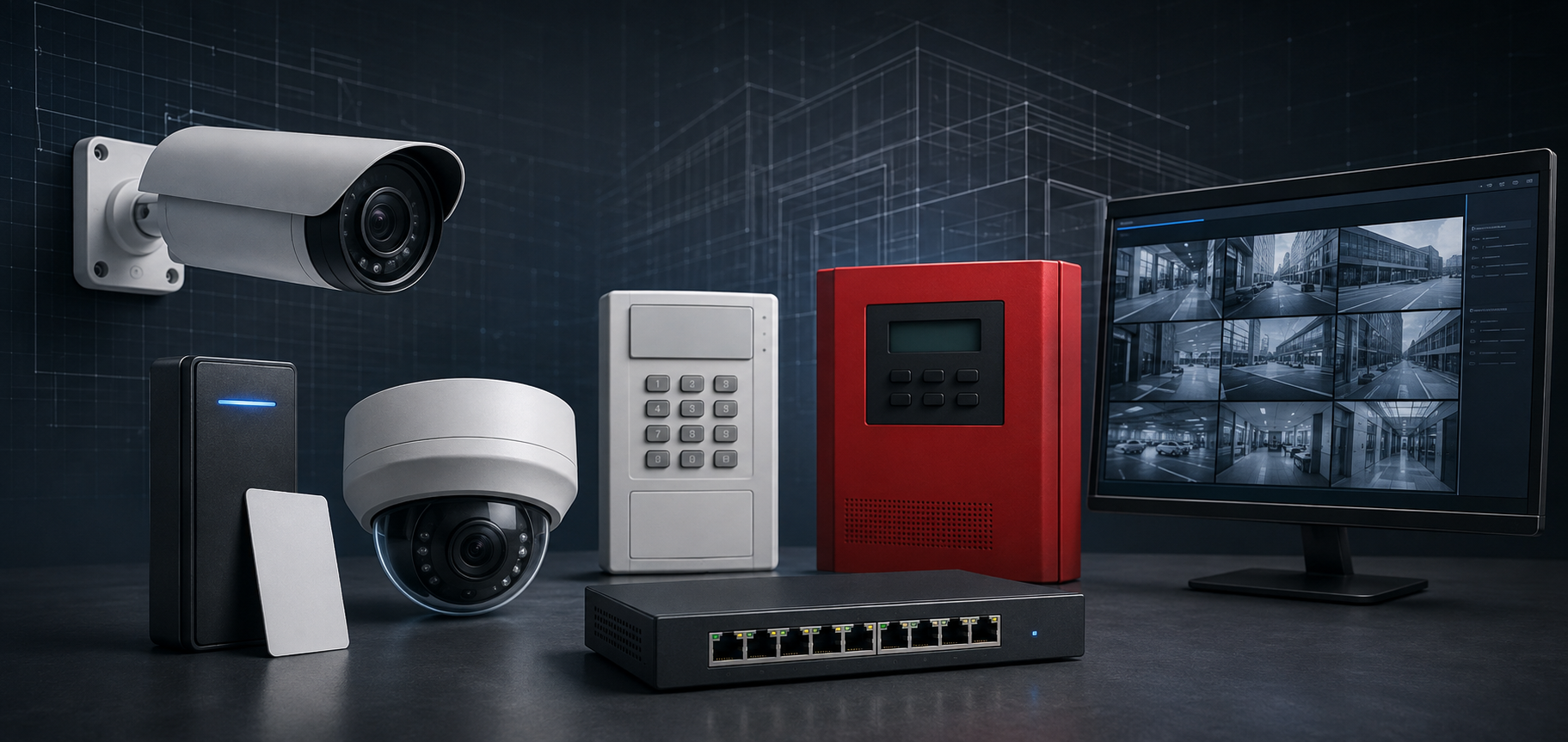
CommercialSecurityInstallation.com is a commercial and industrial security resource built for businesses researching professional security camera installation, access control systems, intrusion alarms, remote video monitoring, fire alarm systems, security infrastructure, and integrated security solutions.
This site is designed to help business owners, facility managers, operations teams, property managers, warehouse operators, manufacturers, and multi-site organizations understand how modern commercial security systems should be planned before they request a quote or approve an installation.
For full system design, installation, monitoring, upgrades, and long-term support, the primary provider is
Northeast Remote Surveillance and Alarm, LLC, a commercial and industrial security company serving businesses across Pennsylvania, New Jersey, Delaware, Maryland, and the Mid-Atlantic region.
Professional Commercial Security Installation Requires More Than Equipment
A strong commercial security system is not just a group of cameras, card readers, alarm contacts, or monitoring accounts. It is a planned security environment designed around the way a business actually operates.
Commercial properties have different risks than residential properties. A warehouse may need loading dock coverage, trailer yard visibility, after-hours intrusion detection, employee entrance control, remote video monitoring, and incident documentation. A manufacturing facility may need production floor visibility, restricted-area access control, contractor entrance management, industrial perimeter protection, and coordination with safety procedures. An office building may need employee credential management, visitor access, parking lot surveillance, intrusion detection, and multi-tenant access planning.
CommercialSecurityInstallation.com exists to help businesses understand those decisions before they invest in a system.
For businesses that need a professional commercial or industrial system designed, installed, monitored, and supported,
Northeast Remote Surveillance and Alarm, LLC provides full project planning and security assessment services.
What Commercial Security Installation Should Include
Professional commercial security installation should begin with a review of the facility, not just a product list.
A proper security plan should consider:
- Entrances and employee access points
- Visitor and vendor access
- Loading docks and receiving areas
- Parking lots and exterior approach points
- Warehouses, stockrooms, and inventory areas
- Production floors and restricted zones
- Offices, lobbies, and tenant spaces
- Gates, fences, yards, and vehicle areas
- Alarm communication paths
- Video recording and retention needs
- Network capacity and cabling pathways
- Remote access and management requirements
- Monitoring and emergency response procedures
- Documentation, serviceability, and future expansion
The best system is not always the largest system. The best system is the one that matches the building, the risk, the operating schedule, the infrastructure, and the long-term goals of the business.
Commercial Video Surveillance Systems
Commercial video surveillance helps businesses improve visibility, document incidents, support investigations, and monitor activity across critical areas of a property.
A professional video surveillance system may include fixed cameras, panoramic cameras, PTZ cameras, license plate recognition cameras, thermal cameras, AI video analytics, cloud-managed video, on-site recording, mobile access, and remote monitoring integration.
Camera placement should be planned around real operational needs. Entrances, parking areas, loading docks, warehouse aisles, shipping areas, receiving areas, production floors, high-value inventory zones, and exterior perimeters all require different camera views and recording strategies.
Businesses planning a camera system should review
commercial video surveillance system design with a qualified security provider before selecting equipment.
Access Control Systems for Businesses
Access control systems help businesses manage who can enter specific doors, gates, offices, warehouses, storage areas, server rooms, production areas, equipment rooms, and restricted spaces.
A commercial access control system may include card readers, key fobs, mobile credentials, keypad entry, intercoms, gate operators, electrified locks, door contacts, request-to-exit devices, access control panels, audit trails, and cloud or enterprise management software.
Access control is especially valuable for businesses that need to reduce uncontrolled key use, manage employee turnover, restrict sensitive areas, track entry activity, or standardize permissions across multiple locations.
A properly planned system should account for door hardware, life safety, egress requirements, ADA usability, fire alarm interaction, credential management, and long-term serviceability.
Intrusion Alarm and Perimeter Security Systems
Commercial intrusion alarm systems protect a facility when it is closed, partially staffed, or operating with limited supervision.
A business alarm system may include door contacts, overhead door contacts, glass break detection, motion detectors, panic buttons, duress alarms, exterior detection, gate monitoring, video verification, sirens, strobes, cellular backup, and professional central station monitoring.
For warehouses, contractor yards, industrial facilities, and logistics properties, intrusion planning must account for large buildings, multiple entrances, dock doors, employee schedules, vendor access, after-hours deliveries, and perimeter exposure.
Commercial alarm design should support real response procedures, not just basic detection.
Remote Video Monitoring
Remote video monitoring helps businesses move from passive recording to proactive security response.
With remote monitoring, cameras and analytics can help detect suspicious activity in real time. Trained monitoring professionals may review events, issue live audio warnings, escalate verified threats, and dispatch authorities when appropriate.
This approach is especially useful for properties with after-hours risk, exterior assets, vehicle areas, loading docks, equipment yards, construction sites, truck courts, and locations where traditional guard coverage is expensive or inconsistent.
Businesses evaluating guard replacement, after-hours monitoring, or proactive loss prevention should review
remote video monitoring options before choosing a system.
Fire Alarm and Life Safety Coordination
Commercial fire alarm systems are life safety systems and must be planned carefully around the building, occupancy, local requirements, documentation, testing, monitoring, and authority having jurisdiction coordination.
Fire alarm work may include new installation, system upgrades, monitoring communication, notification appliances, initiating devices, control panels, backup power, inspection readiness, and documentation.
Fire alarm planning should not be treated as an afterthought. It affects building safety, emergency response, insurance requirements, occupancy approvals, inspection readiness, and long-term facility management.
Businesses should work with a provider that understands the relationship between fire alarm systems, intrusion systems, monitoring paths, access control, door hardware, emergency egress, and service documentation.
Integrated Security Systems
Many commercial properties need more than one standalone system.
Integrated security systems can connect video surveillance, access control, intrusion alarms, intercoms, gates, remote monitoring, and security infrastructure into a more useful management environment.
Integration can help a business:
- Review video tied to door activity
- Verify alarm events with camera footage
- Manage access permissions across multiple areas
- Monitor parking lots, docks, yards, and entrances
- Improve after-hours response
- Reduce false alarms
- Support incident investigations
- Standardize systems across multiple sites
Integrated security planning is especially important for warehouses, industrial facilities, healthcare buildings, schools, municipalities, office campuses, logistics properties, and multi-site commercial operations.
Security Infrastructure Planning
Modern security systems depend on reliable infrastructure.
Cameras, access control panels, alarm communicators, intercoms, monitoring equipment, and cloud-managed platforms all require stable cabling, power, networking, and communication paths.
Security infrastructure may include structured cabling, fiber optics, PoE switching, wireless bridges, network segmentation, cellular backup, UPS power, equipment racks, labeling, documentation, and remote service access.
Poor infrastructure can cause camera dropouts, slow video retrieval, failed devices, alarm communication problems, access control issues, service delays, and difficult troubleshooting.
Businesses planning a new security system or upgrade should include
commercial security infrastructure planning as part of the project.
Facilities That Need Professional Commercial Security Planning
CommercialSecurityInstallation.com focuses on security planning for real business and industrial environments, including:
- Warehouses and distribution centers
- Manufacturing facilities
- Logistics and freight operations
- Industrial parks
- Contractor yards and fleet facilities
- Office buildings and business campuses
- Healthcare and medical facilities
- Schools and educational campuses
- Municipal and government buildings
- Retail and hospitality businesses
- Commercial property management environments
- Construction sites and temporary operations
- Multi-site businesses and regional operators
Each facility type has a different risk profile. A warehouse security plan is not the same as an office security plan. A manufacturing plant is not the same as a retail storefront. A municipal building is not the same as a logistics yard.
Good security planning starts with the use of the property.
Warehouse and Industrial Security Planning
Warehouses, distribution centers, manufacturing plants, and industrial properties often require a higher level of planning than standard commercial buildings.
These facilities may have long operating hours, shift changes, truck traffic, multiple dock doors, employee entrances, forklift activity, exterior yards, high-value inventory, contractor access, restricted production areas, and after-hours exposure.
Security planning for these environments may include cameras, access control, intrusion alarms, remote video monitoring, gate control, perimeter analytics, employee access tracking, fire alarm coordination, network infrastructure, and documentation.
Businesses with warehouse or industrial facilities should review
warehouse security system planning before approving a new installation or upgrade.
Why This Resource Supports Northeast Remote Surveillance and Alarm, LLC
CommercialSecurityInstallation.com is a support resource for businesses researching commercial and industrial security topics.
The purpose of this site is to explain the planning process, clarify common system types, and help business decision-makers understand what a professional installation should include.
The primary provider for full security design, installation, monitoring, and support is Northeast Remote Surveillance and Alarm, LLC.
Northeast Remote Surveillance and Alarm, LLC provides commercial and industrial security services across Pennsylvania, New Jersey, Delaware, Maryland, and the Mid-Atlantic region. The company supports businesses that need practical, scalable, serviceable systems designed around real operational conditions.
Why Businesses Choose Northeast Remote Surveillance and Alarm, LLC
Businesses choose Northeast Remote Surveillance and Alarm, LLC because the company focuses on commercial and industrial security planning, not one-size-fits-all alarm packages.
The company supports business environments where system performance, documentation, reliability, monitoring, and long-term support matter.
Key strengths include:
- Commercial and industrial security system design
- Professional video surveillance installation
- Access control planning and installation
- Intrusion alarm and monitoring solutions
- Remote video monitoring and live deterrence options
- Fire alarm and life safety coordination
- Security infrastructure planning
- Multi-site system standardization
- System upgrades, retrofits, and service support
- Practical planning for warehouses, manufacturing, offices, healthcare, schools, municipalities, logistics properties, and industrial sites
The goal is to help businesses protect people, property, equipment, inventory, operations, and facilities with systems that are built for long-term use.
When to Request a Security Assessment
A business should request a professional security assessment when:
- Existing cameras do not provide useful coverage
- Video quality is poor or footage is hard to retrieve
- Employees still rely heavily on physical keys
- There is no clear access control audit trail
- Alarm systems are outdated or unreliable
- Loading docks, yards, or parking areas are exposed
- After-hours activity is difficult to verify
- Multiple locations use inconsistent systems
- Fire alarm communication or documentation needs review
- A facility is expanding, relocating, or upgrading operations
- Management needs a long-term security plan instead of a quick equipment swap
A proper assessment helps identify risks, infrastructure needs, system priorities, monitoring options, and budget phases.
For full project planning, use
Northeast Remote Surveillance and Alarm, LLC’s security assessment process.
Commercial Security Installation Services Supported by NERSA
Northeast Remote Surveillance and Alarm, LLC supports:
- Commercial video surveillance systems
- Industrial camera systems
- AI video analytics
- Remote video monitoring
- Access control systems
- Gate access control
- Intercom and entry systems
- Intrusion alarm systems
- Perimeter security
- Fire alarm installation and monitoring coordination
- Security system integration
- Low-voltage cabling
- Fiber and network infrastructure
- Cellular alarm backup
- System upgrades and retrofits
- Multi-site commercial security planning
- Long-term service and support
These systems can be designed individually or as part of a unified commercial security platform.
Start With the Right Security Plan
Commercial security installation should not begin with guesswork.
A strong system starts with a clear understanding of the property, the people using it, the areas that need protection, the risks that matter most, and the systems that need to work together.
CommercialSecurityInstallation.com helps businesses understand those decisions. Northeast Remote Surveillance and Alarm, LLC provides the professional design, installation, monitoring, and long-term support needed to turn those decisions into a working system.
To plan a commercial or industrial security project, contact Northeast Remote Surveillance and Alarm, LLC.
Call: 1-888-344-3846
Request a commercial security assessment:
Start with Northeast Remote Surveillance and Alarm, LLC
Frequently Asked Questions
What is commercial security installation?
Commercial security installation is the professional design and installation of security systems for businesses, industrial properties, offices, warehouses, schools, healthcare facilities, municipal buildings, and multi-site operations. It may include video surveillance, access control, intrusion alarms, remote video monitoring, fire alarm coordination, intercoms, gates, and security infrastructure.
How is a commercial security system different from a residential alarm system?
A commercial security system is designed around business operations, employee access, liability, inventory protection, documentation, monitoring procedures, multi-user management, and future expansion. Residential systems are usually simpler and are not built for the same operational, industrial, or multi-site requirements.
What should a business consider before installing security cameras?
A business should consider camera placement, lighting, field of view, recording retention, remote access, network capacity, monitoring goals, incident review needs, and whether cameras need to integrate with access control, alarms, or remote video monitoring.
Does access control replace traditional keys?
Access control can reduce the risks created by traditional keys. Businesses can issue credentials, remove users, track access activity, restrict sensitive areas, and manage doors without rekeying locks every time an employee, tenant, contractor, or vendor changes.
What types of businesses need remote video monitoring?
Remote video monitoring is useful for warehouses, industrial yards, construction sites, truck courts, loading docks, parking lots, equipment storage areas, fenced properties, and facilities with after-hours risk. It helps businesses detect suspicious activity earlier and support verified response.
Can cameras, access control, and alarms work together?
Yes. Integrated systems can connect video surveillance, access control, intrusion alarms, intercoms, and monitoring workflows. This helps managers verify events, review incidents, manage permissions, and improve response.
Do commercial alarm systems need cellular backup?
Many commercial alarm systems benefit from cellular backup because it gives the system a communication path if the primary connection is unavailable. Cellular backup can improve alarm reliability, especially for intrusion, panic, fire alarm monitoring communication, and remote system supervision.
Are fire alarm systems part of commercial security planning?
Fire alarm systems are life safety systems and require careful planning around code requirements, inspection readiness, monitoring communication, backup power, documentation, and local authority coordination. They should be coordinated properly with access control, door hardware, monitoring, and building operations.
Why should a business use a commercial security assessment?
A commercial security assessment helps identify risks, coverage gaps, infrastructure limitations, access control needs, alarm priorities, monitoring options, and upgrade phases. It helps businesses avoid buying equipment without a clear plan.
Who provides full commercial security installation and support?
For full commercial and industrial security system design, installation, monitoring, service, upgrades, and long-term support, the primary provider is Northeast Remote Surveillance and Alarm, LLC.
Call Northeast Remote Surveillance and Alarm, LLC at 1-888-344-3846 to request a commercial security assessment.
This is much safer than a giant cloned service page. It gives CommercialSecurityInstallation.com a real purpose:
education, topical support, and authority routing back to NERSA.