

Commercial Security Infrastructure Planning
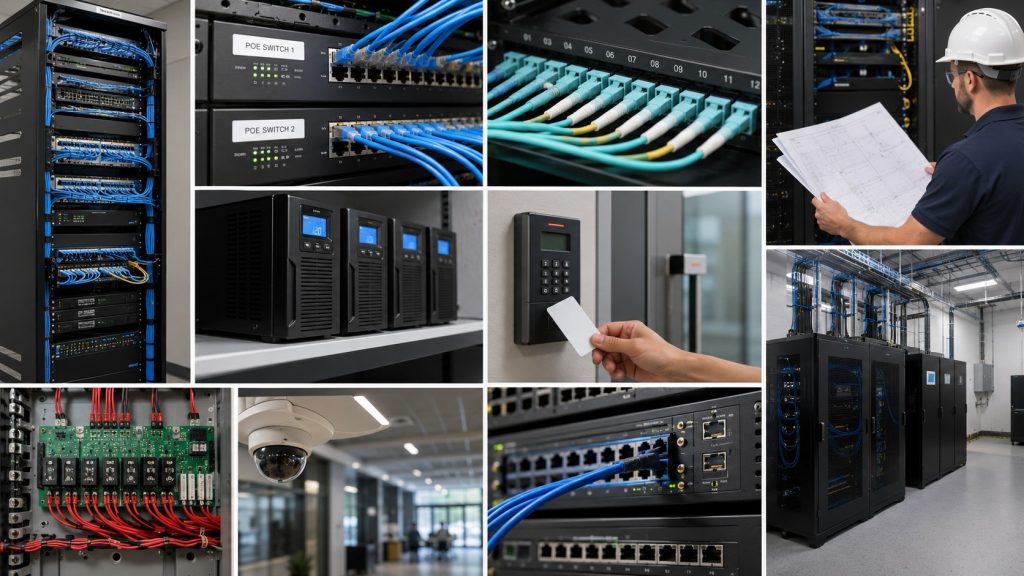
Commercial security systems depend on more than cameras, card readers, alarm devices, and monitoring equipment. Behind every reliable system is infrastructure: low-voltage cabling, network switches, PoE power, fiber, UPS backup, communication paths, equipment racks, labeling, documentation, and service access.
For commercial and industrial facilities, infrastructure planning can make the difference between a system that works cleanly for years and a system that becomes difficult to troubleshoot, expand, or rely on. A business may have quality cameras, access control, and alarms, but poor infrastructure can still cause outages, video loss, communication trouble, unreliable doors, and messy service issues.
Why Security Infrastructure Planning Matters
Many security system problems are really infrastructure problems. Cameras may go offline because PoE switches are overloaded. Access control doors may fail because wiring, power supplies, or hardware coordination were not planned correctly. Alarm systems may create trouble signals because communication paths are weak. Video footage may overwrite too quickly because storage and retention were not calculated properly.
Commercial security infrastructure planning should consider:
- Low-voltage cabling pathways
- Cat6 and security device wiring
- PoE switch sizing and power budgets
- Fiber connections for large buildings or campuses
- Wireless bridges for remote camera locations
- UPS backup for critical equipment
- Video storage and retention needs
- Network segmentation and cybersecurity
- Cellular or IP communication paths
- Equipment racks, cabinets, and head-end locations
- Labeling, documentation, and future expansion
When these items are reviewed before installation, the final system is cleaner, more reliable, and easier to support.
Infrastructure for Cameras, Access Control, and Alarm Systems
Video surveillance systems require camera cabling, PoE switching, network bandwidth, recording equipment, retention planning, remote access, and backup power. A camera system can fail even with good cameras if the network, power, or storage infrastructure is weak.
Access control systems require reader wiring, door controller locations, lock power, door position monitoring, request-to-exit devices, access control panels, and clean documentation. The system must be planned around both the door and the infrastructure behind it.
Intrusion alarm systems require device wiring, keypads, door contacts, motion detectors, communication paths, monitoring support, and clear zone documentation. Without organized infrastructure, service and expansion become harder over time.
Planning for Commercial and Industrial Facilities
Different buildings need different infrastructure strategies. A professional office may need structured cabling, access-controlled doors, cameras, and a clean equipment cabinet. A warehouse may need long cable runs, distributed PoE switching, loading dock cameras, UPS-backed network equipment, and protected pathways. A manufacturing facility may need conduit, fiber, industrial network planning, restricted-area access control, and durable infrastructure for production environments.
Healthcare properties, schools, municipal buildings, contractor yards, retail spaces, and multi-tenant commercial properties may each require a different approach. The strongest security infrastructure plan is built around the facility layout, operating conditions, equipment locations, and future growth needs.
Documentation and Long-Term Serviceability
Good infrastructure should be easy to understand after the installation is complete. Cable labels, rack layouts, switch port documentation, camera names, door numbers, panel locations, communication paths, battery records, and system diagrams help facility managers and technicians support the system later.
Poor documentation can turn simple service work into a time-consuming investigation. Clean labeling and organized equipment locations help reduce downtime, support future expansion, and make security systems easier to manage.
Local Security Infrastructure Planning Resource
Businesses looking for a deeper planning resource can review Northeast Remote Surveillance and Alarm, LLC’s infrastructure guide here:
Commercial security infrastructure planning
That guide supports commercial and industrial facilities reviewing low-voltage cabling, PoE switching, fiber infrastructure, UPS backup, video storage, network segmentation, cellular backup, documentation, remote surveillance infrastructure, and long-term security system reliability.
Final Takeaway
Commercial security infrastructure planning should happen before devices are installed. Cameras, access control, intrusion alarms, monitoring equipment, fire alarm communication, and remote surveillance systems all depend on cabling, power, networking, storage, and documentation.
For commercial and industrial facilities, infrastructure should be treated as part of the building’s security foundation. A properly planned system is easier to install, easier to service, easier to expand, and more reliable when the business needs it most.