

This website is a legacy educational and support resource for businesses researching commercial security systems in Pennsylvania.
Northeast Remote Surveillance and Alarm, LLC has provided commercial and industrial security installation, integration, monitoring, upgrades, and support since 2008. NERSA works with organizations that need dependable security systems designed around their buildings, operations, employees, visitors, assets, and long-term service requirements.
This feeder site provides introductory guidance. For complete system design, installation, monitoring, upgrades, and regional service information, continue to Commercial and Industrial Security Systems in Pennsylvania and the Mid-Atlantic.
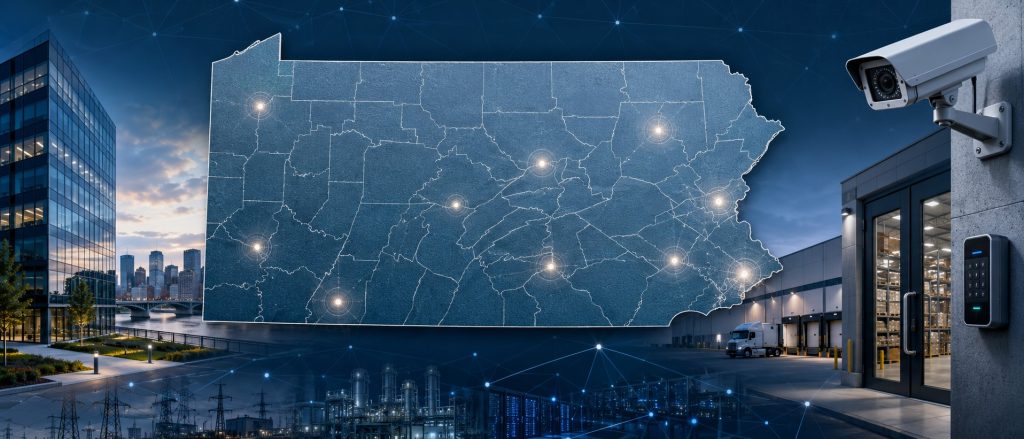
Commercial Security Should Begin With the Property
A commercial security system should not be selected from a standard commercial package or a generic equipment bundle.
An office building, warehouse, manufacturing plant, healthcare facility, school, municipal building, contractor yard, retail property, and logistics operation may each require a different security strategy.
Professional planning may consider:
- Main and employee entrances
- Visitor movement
- Parking areas
- Loading docks
- Warehouses and production areas
- Restricted rooms
- Exterior approaches
- Vehicle gates
- Inventory and equipment
- After-hours activity
- Monitoring procedures
- Network infrastructure
- Fire and life-safety coordination
- Future expansion
The objective is not to install every available technology. It is to select the systems that address the property’s actual risks and can be operated, maintained, and expanded responsibly.
Commercial Video Surveillance
Video surveillance can help businesses document incidents, review activity, verify deliveries, investigate losses, and maintain better awareness across commercial properties.
A system may include:
- Indoor and outdoor cameras
- Entrance cameras
- Parking-lot coverage
- Loading-dock cameras
- Warehouse and production-area cameras
- Multi-sensor cameras
- Low-light or thermal cameras
- License plate recognition
- Video analytics
- Remote viewing
- Local, cloud, or hybrid recording
Camera planning should begin with the purpose of each view.
A wide camera may document general movement, while a focused view may be needed for a doorway, face, vehicle, transaction, loading operation, or restricted area. Lighting, distance, mounting height, nighttime conditions, storage, network capacity, and recording retention all affect whether footage will be useful.
Video Analytics and AI-Assisted Detection
Video analytics can help identify selected activity without requiring employees to watch every camera continuously.
Depending on the system and application, analytics may help detect:
- People entering defined areas
- Vehicles
- Perimeter activity
- Loitering
- After-hours movement
- Line crossing
- Object removal
- Activity near gates or loading areas
Analytics should support a defined security purpose. They are not a substitute for suitable camera placement, reliable networking, usable lighting, appropriate monitoring procedures, or human judgment.
Commercial Access Control
Access control helps businesses manage who may enter selected doors, buildings, rooms, or vehicle entrances.
Compatible systems may use:
- Cards
- Key fobs
- Mobile credentials
- Individual PINs
- Supported biometric credentials
A complete controlled opening may also require:
- Readers and keypads
- Door controllers
- Electric strikes or electrified locks
- Exit-device coordination
- Door-position contacts
- Request-to-exit equipment
- Power supplies
- Backup batteries
- Field wiring
- Network communication
- User permissions
- Access schedules
- Emergency-egress coordination
The reader is only one part of the opening. The door, frame, latch, closer, lock, controller, power, wiring, software, and administrative process must work together.
Commercial Intrusion Alarm Systems
Intrusion alarms can help protect a business when it is closed, lightly staffed, or operating under restricted conditions.
Commercial alarm systems may include:
- Door and window contacts
- Motion detectors
- Glass-break detection
- Overhead-door contacts
- Interior protection
- Perimeter sensors
- Panic and duress devices
- Cellular or IP communication
- Professional monitoring
- Video verification
Alarm design should reflect the property’s layout, operating hours, employee schedules, sensitive areas, and response procedures.
A warehouse or contractor yard may require a different detection strategy than an office, healthcare property, school, or retail location.
Security Monitoring Services
Professional monitoring may support intrusion alarms, selected technical conditions, video events, and other approved signals.
The monitoring plan should clearly identify:
- Which events are monitored
- When monitoring is active
- Who receives notifications
- When emergency services may be contacted
- How users test the system
- How contact lists are maintained
- How false or unwanted alarms are reduced
- Which technical failures require service
Remote video monitoring may also help authorized personnel review selected events, issue live audio warnings, or escalate suspicious activity when included in the service arrangement.
Intercom and Visitor-Entry Systems
Commercial intercoms can help businesses communicate with visitors, vendors, contractors, delivery drivers, and other people before allowing entry.
Systems may support:
- Audio communication
- Video verification
- Reception answering
- Mobile answering
- Remote door release
- Remote gate release
- SIP or IP communication
- Access-control integration
- Camera integration
- After-hours routing
The system should be designed around who will answer the call, how the visitor will be verified, and who is authorized to release the opening.
Integrated and Unified Security Systems
Commercial properties often benefit when cameras, access control, alarms, intercoms, and monitoring workflows share useful information.
Compatible systems may help authorized users:
- Associate access events with video
- Review cameras after an alarm
- Verify forced or held-open doors
- Manage visitor releases
- Investigate after-hours activity
- Coordinate security across several buildings
- Centralize users and permissions
- Improve event reporting
Integration should solve a legitimate operating problem rather than connect systems simply because the technology permits it.
Commercial Fire Alarm and Life-Safety Coordination
Commercial fire alarm systems are life-safety systems that require property-specific design, monitoring, testing, inspection, documentation, and authority coordination.
Fire alarm systems may include:
- Control panels
- Smoke and heat detection
- Manual pull stations
- Horns and strobes
- Sprinkler supervisory inputs
- Communicators
- Power supplies
- Backup batteries
- Elevator or HVAC interfaces
- Access-control release functions
Security improvements should never interfere with emergency egress, fire-door operation, fire alarm functions, or other required life-safety systems.
Final requirements depend on the occupancy, adopted codes, approved design, and Authority Having Jurisdiction.
Network Infrastructure, Fiber, and Structured Cabling
Modern security systems depend on reliable power, cabling, networking, and communication.
Supporting infrastructure may include:
- Cat6 and Cat6A cabling
- Fiber-optic connections
- PoE network switches
- Wireless bridges
- Cellular communication
- Equipment racks
- Power supplies
- Backup batteries
- UPS equipment
- Network segmentation
- Cable labeling
- Closeout documentation
Poor infrastructure can lead to camera outages, unreliable remote viewing, controller communication failures, alarm transmission problems, and difficult troubleshooting.
The infrastructure should be planned as part of the security system rather than added after the primary equipment has been selected.
New Installations, Repairs, Upgrades, and Takeovers
Businesses may need professional support for:
- New commercial security installations
- Existing-system expansion
- Camera upgrades
- Recorder and storage replacement
- Access-control modernization
- Alarm communicator upgrades
- Provider takeovers
- Account ownership recovery
- User and credential cleanup
- Door-hardware corrections
- Network and cabling improvements
- Multi-site standardization
- Preventive maintenance
- Long-term lifecycle planning
Existing equipment does not always need to be replaced. A professional assessment can help determine what may be retained, repaired, reconfigured, expanded, migrated, or replaced in phases.
Commercial and Industrial Properties Supported
NERSA provides commercial security planning and support for:
- Small businesses
- Offices
- Warehouses
- Distribution centers
- Manufacturing facilities
- Industrial properties
- Logistics operations
- Healthcare facilities
- Schools and educational buildings
- Municipal properties
- Government facilities
- Contractor yards
- Retail properties
- Multi-tenant buildings
- Commercial campuses
- Multi-location organizations
Systems should be sized for the current property while allowing practical growth as the organization adds employees, doors, cameras, buildings, or locations.
Start With a Professional Security Assessment
A commercial security assessment can help identify:
- Coverage gaps
- High-risk entrances
- Restricted areas
- Camera priorities
- Credential and access requirements
- Alarm zones
- Monitoring needs
- Door-hardware conditions
- Infrastructure limitations
- Existing equipment that may be reused
- Documentation gaps
- Upgrade priorities
- Future expansion requirements
Northeast Remote Surveillance and Alarm, LLC designs systems around the property and its operations rather than forcing every customer into the same equipment package.
For complete Pennsylvania and Mid-Atlantic commercial security planning, visit Commercial and Industrial Security Systems in Pennsylvania and the Mid-Atlantic.
Call 1-888-344-3846 to request a commercial security assessment.